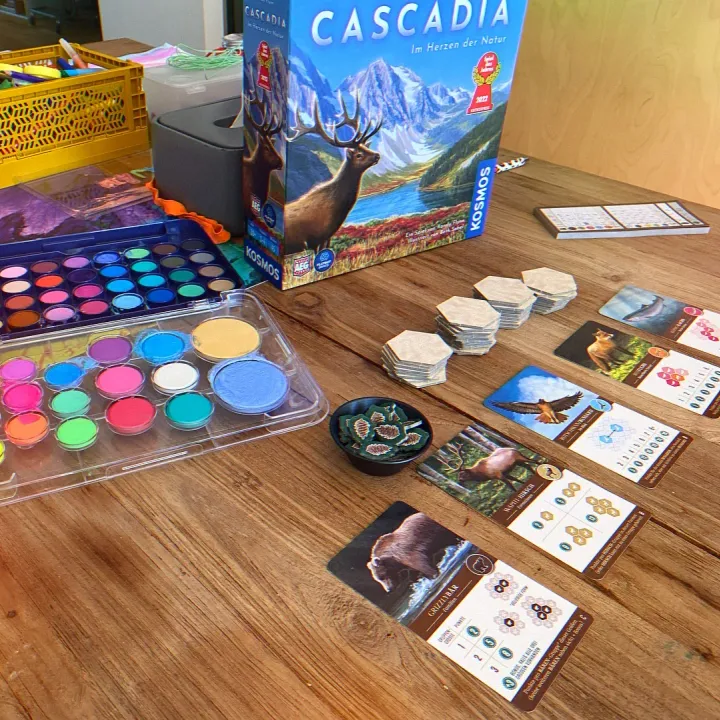
The parents are playing, the kids are drawing. That’s how Cascadia hit our table on a Sunday morning, and it’s a pretty good advertisement for the game.
Cascadia is calm. It’s beautiful. It’s not a game of big drama, and it doesn’t try to be. Here’s why it keeps coming back to our table anyway.
What is Cascadia?
Cascadia is a tile-laying game about the habitats and wildlife of the Pacific Northwest. You build your own landscape out of hexagonal habitat tiles and fill it with animals.
It’s designed by Randy Flynn, illustrated by Beth Sobel and published by Flatout Games and AEG, with Kosmos handling the German edition. It plays one to four, takes about 45 minutes and won the Spiel des Jahres in 2022.
How it plays
The publisher sums up the core rule as “pick one, place one”, and that’s pretty much it:
- Pick. In the middle of the table are four pairs, each a habitat tile plus a wildlife token. Take one pair.
- Place. Add the tile to your landscape, then put the animal on a tile that fits it.
- Score. Each species scores in its own way, decided by scoring cards that change every game. Bears might want pairs, hawks might want to be alone. On top of that, your largest connected area of each habitat earns points.
There’s a little wiggle room, too. Pinecone-shaped nature tokens let you take any tile with any animal, or swap out the animals on offer. Leftover pinecones are worth a point each at the end.
Why we love it
It’s really beautiful. We’ve said it before and we’ll say it again. The art does a lot of work here. Play it on a quiet morning and you can almost hear the waterfall splashing and the animals roaming around.
It fits a slow Sunday. The parents play, the kids draw. For the two of us on a Sunday morning, it was perfect timing for Cascadia.
The cards are actually good. This sounds like a small thing until you’ve played the alternatives. When I first played Harmonies, I noticed its cards were thin and poorly coated, something others in the community had mentioned too. The cards in Cascadia, like those in Everdell or Wingspan, are much better made.
It made the cut. Cascadia once made our list of the month, alongside games like Harmonies, Forest Shuffle, Everdell and Wingspan.
Cascadia or Harmonies?
This is the comparison everyone makes, and we made it too. After my first game of Harmonies, I described it as a mix of Azul and Cascadia.
| Cascadia | Harmonies | |
|---|---|---|
| Where you build | An open landscape that grows in every direction | Your own board, with 3D stacking |
| Cards | Much better made | Thin, poorly coated |
Cascadia
- Where you build
- An open landscape that grows in every direction
- Cards
- Much better made
Harmonies
- Where you build
- Your own board, with 3D stacking
- Cards
- Thin, poorly coated
If you love a landscape that sprawls, Cascadia. If you want a tighter puzzle with a bit of stacking, Harmonies. More on that in our Harmonies review.
Where it stings
Cascadia is gentle, and for some tables gentle means boring. There’s little direct interaction. You mostly work on your own landscape, and your only real influence on the others is what you leave in the middle.
The scoring takes some brainpower. Because every animal scores differently and the cards change each game, it’s easy to lose track, or to build for last game’s rules by accident. And games slow down with more players, when you wait longer for your turn.
Cascadia with kids
Our box says 10+, like the publisher’s page. That makes sense to us: the basic rules are easy, but the scoring is tricky to track.
I don’t have a kids’ report on Cascadia yet. On the Sunday morning we posted about, the kids were busy drawing. If you want to try it with younger players, the box includes a family variant: one scoring card that scores every animal the same way, by group size. We haven’t tried it yet.
What we hear in the community
Cascadia won the 2022 Spiel des Jahres as an attractive, accessible feel-good game where you achieve something on every turn. People praise the nature artwork, the sturdy wooden tokens and thick tiles, rules you can teach in minutes, and a strong solo mode with scenarios.
The Wingspan comparison comes up a lot: a similar mood, with much lighter mechanics. On the downside, you sometimes hear that it can feel repetitive after many plays.
There’s also an expansion, Cascadia Landmarks, which raises the player count to six. We haven’t played it, or the solo mode. If you have, tell us whether it’s worth it.
Our verdict
If you want a beautiful, calm puzzle for two on a slow morning, or a peaceful game for families of all kinds who’d rather not fight at the table, Cascadia is a great pick.
If your table lives for stealing, blocking and trash talk, skip it. And if Harmonies is already on your shelf, think twice. Cascadia doesn’t want to win an argument. It just wants you to enjoy the view.

Where it shines
- A really beautiful game
- Peaceful enough for a slow Sunday morning
- Sturdier cards than many of its rivals, Harmonies included
- Simple to pick up, and the scoring changes every game

Where it stings
- Little direct interaction
- Keeping track of how each animal scores takes effort
- If you already own Harmonies, the overlap is real
Fact sheet
- 1–4
- about 45 min (publisher)
- 10+
- Randy Flynn
FAQ
Is Cascadia good with two players?
Yes. We've played it as a couple on a Sunday morning while the kids were drawing, and it was perfect for that.
Cascadia or Harmonies: which should I buy?
Harmonies feels like a mix of Azul and Cascadia, with 3D stacking on your own board. Cascadia is more open and sprawling, and its cards are clearly better made. We like both.
How long does a game of Cascadia take?
The publisher says about 45 minutes, for one to four players.
What age is Cascadia for?
The box says 10+. There's a family variant with simpler scoring, which we haven't tried yet.
Does Cascadia have a solo mode?
Yes, and it has a great reputation in the community. We haven't played it solo.


