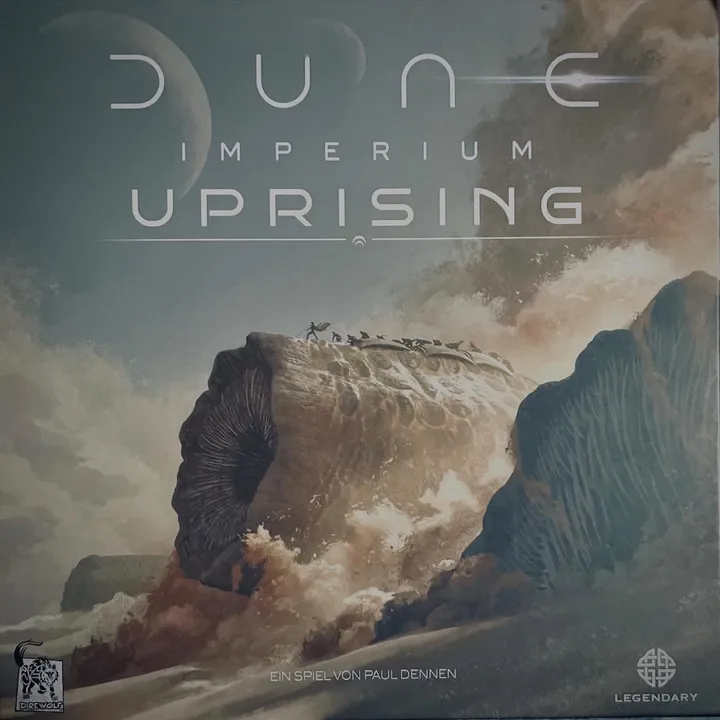
Our first evening with Dune: Imperium – Uprising, with three beginners at the table, was complex and long. The next day, we played again. That’s when the game really shined.
Fast forward: in our game database, Uprising is one of only a handful of games with a perfect 10. It’s not easy, it’s not quick to teach, and it’s absolutely fantastic.
What is Dune: Imperium – Uprising?
Uprising is a standalone game set in the Dune universe. It combines deck-building with worker placement: you play cards from your hand to send agents to locations on the board, gather resources, build influence with the factions and send troops into conflicts. Your deck grows over the game as you buy new cards.
It was designed by Paul Dennen and published by Dire Wolf in 2023. The publisher calls it a standalone expansion. It comes with its own board and is meant to work as a starting point for new players. So no, you don’t need the original.
It’s also compatible with the original Dune: Imperium. According to the designer, all of the original’s leaders and nearly all of its cards work with Uprising.
How it plays
The goal is simple: be the first to 10 victory points, or lead when the conflict deck runs out. Getting there is the hard part.
- Cards send agents. Each card shows which board spaces it can send an agent to. That’s the rule that trips up newcomers most, so it’s best to teach it first.
- Conflicts. You send troops into conflicts to win their rewards. In Uprising, conflict cards also carry symbols that score you points if you collect matching ones.
- Spies. Everyone starts with three. You post them next to board spaces, and calling one back lets you draw a card or sneak an agent onto a space someone else already took. Fewer “you blocked me, again” moments.
- Sandworms. You need a Maker Hook, earned through the Fremen, and water to call a worm. A worm adds serious strength in a fight and doubles that conflict’s rewards. Some locations are protected by the shield wall until someone breaks it.
- Contracts. An optional module where you take on CHOAM contracts for rewards. The publisher built it to be modular, with a simpler option for new players.
Sounds like a lot? It is. Which brings us to our first evening.
The first game: rough. The second: wow.
Let’s be honest about the start. Uprising is not easy to explain, and with three beginners, our first game felt pretty complex and took quite a while.
But the next game? Full tension, head-to-head until the very end, with every decision feeling impactful. That’s the game we fell for. If your first evening feels like homework, don’t judge it yet.
Why it’s a 10 for us
It’s really fantastic. Super tense, super thematic. You feel the desert, the politics, the scheming.
And it never lets up. Right to the end, the race stays close and every card you play matters.
Uprising vs. the original
We know the original Dune: Imperium too, and it’s already very good. What makes Uprising better for us isn’t one big new feature. Yes, there are sandworms and other new toys. But what really makes the difference is a lot of small changes. Overall, Uprising simply feels rounder.
On paper, those changes look like this:
| Dune: Imperium | Uprising | |
|---|---|---|
| Do you need the other one? | No | No, it’s standalone |
| New systems | – | Spies, sandworms, optional contracts |
| Board spaces | Includes Mentat and Foldspace | Both gone, Imperial Privilege and Prepare the Way added |
| Third agent | Harder to get | Earlier, via an easier Swordmaster |
| Our pick | Very good | Better, it simply feels rounder |
Dune: Imperium
- Do you need the other one?
- No
- New systems
- –
- Board spaces
- Includes Mentat and Foldspace
- Third agent
- Harder to get
- Our pick
- Very good
Uprising
- Do you need the other one?
- No, it’s standalone
- New systems
- Spies, sandworms, optional contracts
- Board spaces
- Both gone, Imperial Privilege and Prepare the Way added
- Third agent
- Earlier, via an easier Swordmaster
- Our pick
- Better, it simply feels rounder
Which one should you buy? We’d go with Uprising. We hear that a lot in the community, too: most people consider it the better version, and some have even replaced their copy of the original with it. Complete newcomers still get pointed to the original now and then.
There’s also an expansion called Bloodlines, which works with both games, though some of its content needs Uprising. We haven’t played it.
Three is the magic number
With three players, Uprising is optimal for us. With four, it gets a bit long. A game takes us about 90 minutes, sometimes longer.
We’ve also played the six-player team mode, which splits the table into two teams of three. It works, but for us it’s more of a fallback than a first choice.
We haven’t tried two-player or solo. Those modes use Rival cards in place of the missing opponents. In a standard two-player game, the Rival collects resources and scores too, so you’re really facing two opponents. If you want a pure duel, there are streamlined Rivals that only block spaces and don’t score.
The catch: you have to want it
Uprising asks for a commitment. Someone has to learn it well enough to teach it, and the first game will be slow. If your group prefers quick, light games, this is not their evening. If they don’t shy away from complexity, it pays back every minute.
Dune: Imperium – Uprising with kids
The age rating is 13+. We don’t have a kids’ verdict for Uprising, and we can’t say how it plays with children under 13. So this part is about what to expect, not about what happened at our table.
Going by the age rating, this is a game for teens. If you have a strategy-loving teenager, these tips help with the first game:
- Teach the card-to-space rule first. It’s the least familiar idea.
- Three is gentler than four. Smaller tables make for a tighter game. That’s our own sweet spot, too.
- Keep the contracts simple. The CHOAM module has a simpler option for new players.
- Plan ahead for worms. You need Maker Hooks before you can call one, so don’t leave it too late.
- Practice digitally. Dire Wolf’s companion app adds an automated opponent deck for solo and two-player games.
And plan for that slow first evening. Ours was.
What we hear in the community
People praise the tight turns, the spies and the sandworms, and many find the balance cleaner than in the original. Spies and worms also get credit for giving trailing players a way back into the game.
The common criticisms line up with our experience: a steep learning curve, length at four players, and some cards that are only useful in certain situations. Some find the contracts distracting, or the last-minute intrigue points a little cheap if you’re the one who loses. And some find it all rather brown. It’s a desert. Fair enough.
Our verdict
If your group enjoys deep strategy games and is willing to invest an evening, or two, get Dune: Imperium – Uprising. Play it with three if you can. That might be a couple plus a friend, two siblings and a parent, or your chosen family on a Saturday night. It’s one of the very best games in our collection.
If you’re looking for something to pull out on a weeknight with people who rarely play board games, look elsewhere. Uprising wants your full attention, and it deserves it.

Where it shines
- Super tense: head-to-head until the very end
- Super thematic
- Every decision feels impactful
- Many small improvements over the original make it feel rounder overall
- Perfect with three players

Where it stings
- Not easy to explain
- With beginners, the first game feels complex and takes quite a while
- Gets a bit long with four players
- The six-player team mode is more of a fallback for us
Fact sheet
- 1–6 (best with 3 for us)
- about 90 min (our games), sometimes longer
- 13+ to 14+ (listings vary)
- Paul Dennen
- Dire Wolf
- Three or four players, occasionally the team mode
- 10/10
- Automatic Resource Growth, Card Play Conflict Resolution, Contracts, Deck, Bag, and Pool Building, Delayed Purchase, Force Commitment, Increase Value of Unchosen Resources, Multi-Use Cards, Open Drafting, Solo / Solitaire Game, Tags, Team-Based Game, Turn Order: Progressive, Variable Player Powers, Worker Placement
From our table
FAQ
Dune: Imperium or Uprising: which should I buy?
The original is already very good. Uprising is better for us because of many small changes, not just the sandworms: overall, it simply feels rounder. Complete beginners still sometimes get pointed to the original in the community.
What is the best player count for Dune: Imperium – Uprising?
Three players is optimal for us. With four it gets a bit long. The six-player team mode works, but for us it's more of a fallback.
How long does Dune: Imperium – Uprising take?
About 90 minutes for us, sometimes longer. Our first game with three beginners took quite a while.
Is Dune: Imperium – Uprising good for beginners?
It's not easy to explain, and our first game with three beginners felt pretty complex. It's a fantastic experience for anyone who doesn't shy away from complexity and is ready to invest some time.
Do you need the original Dune: Imperium to play Uprising?
No. Uprising is a standalone game. It's also compatible with the original: its leaders and nearly all of its cards work with Uprising.
Can you play Dune: Imperium – Uprising with two players?
Yes. Two-player and solo games use Rival cards in place of missing opponents. We haven't tried those modes ourselves.
What age is Dune: Imperium – Uprising for?
The age rating is 13+. We can't say how it plays with younger kids.