Two words on the table. “Banana.” “Desert.” Now say the word that connects them. Out loud. At the same time as the person next to you. That’s Medium, and it sounds a lot easier than it is.
We had an amazing time with it. Simple rules, fast rounds, lots of laughs. Whether it becomes a regular is a question for a few more game nights.
What is Medium?
Medium is a party word game in which you play “psychic mediums” trying to read each other’s minds. It was designed by Danielle Deley, Lindsey Sherwood and Nathan Thornton, with art by Sarah Kelly, and first released by Greater Than Games in 2019. The box says 2 to 8 players.
The idea comes from an old improv game called Mind Meld. Medium wraps it in neon colors and a crystal ball.
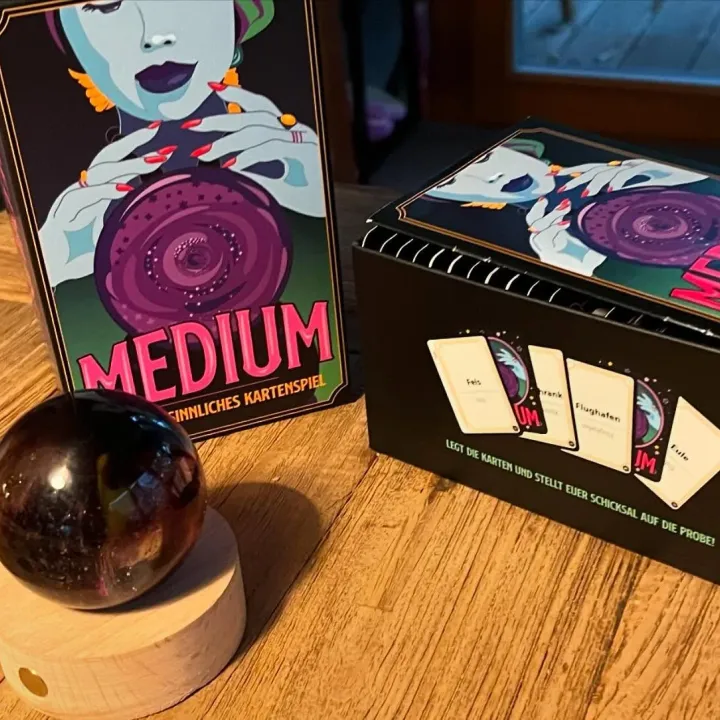
We play the German edition, which we picked up at SPIEL in Essen.
How it plays
You hold a hand of word cards. On a turn, you and your neighbor each put one card face up. Both of you silently think of a single word that links the two, count down, and say it together.
Same word? You score. Different words? Now those two words become the new starting point, and you try again. You get three attempts, and the earlier you match, the more the token is worth.
The scoring has a neat twist: the token sits between the two of you, and at the end you count the tokens on both sides of you. So you want to be on the same wavelength with both neighbors, not just your best friend. The game ends when the third Crystal Ball card turns up.
There are also optional ESP cards that let you jump in on another pair’s guess or redraw your hand.
Where it shines
The rules are simple and the rounds are fast. The game itself happens in everyone’s heads.
And what happens in those heads is the fun part. One of our rounds went from “Banana” and “Desert” to “Sun.” Our session was full of creative ideas, unexpected connections and a lot of laughing.
It fits a casual night with friends just as well as a family table. And since every turn is a pair guessing out loud, nobody sits in a corner waiting. We hear that a lot in the community, too.
Where it stings
Medium is only as good as your group’s wavelength. If the connections don’t come, it’s three attempts of polite confusion, and then the next pair. For some groups, that gets frustrating fast.
That’s also why we’re holding back a little. We had a blast, but one great evening with one group doesn’t make a party staple. We want to try it with a few different groups before we call it.
Player count matters too. The box goes up to eight, but in the community you often hear that it drags at higher counts. Four or five is considered the sweet spot.
Medium with kids
Our database lists Medium at 10+, the publisher’s store lists the English edition at 14+. We haven’t played it with our daughters yet, so we can’t tell you how it lands with a 6- or a 10-year-old.
What we can say: it’s a pure word game. A good vocabulary and a feel for how other people think are the whole skill. Keep that in mind if your kids are still learning to read, or if your table mixes languages.
What we hear in the community
That it’s easy to teach is something we hear again and again. Many find it surprisingly fresh for “yet another party word game”, like how players stay involved even when it isn’t their turn, and see it as a strong family and party game. We also like that the scoring makes you work with both neighbors.
Not everyone is a fan. Inexperienced groups sometimes find matches so rare that the game feels frustrating, and players who want more excitement at the table tend to reach for Just One or So Clover instead. Other complaints you hear: flimsy cards and little catch-up for players who fall behind.
Our verdict
Medium is a clever little word game with a great hook: two brains, one word, three tries. Our night with it was a blast.
Get it if your friends and family like words, quick rounds and laughing at their own wrong guesses. Skip it if your group goes quiet in word games, or if you usually play with seven or eight. And if you’ve played it with a few different crowds, tell us: did it hold up?

Where it shines
- Rules you can explain in a minute
- Fast rounds full of creative connections
- Lots of laughs, especially when you miss
- Works for a casual night with friends or family

Where it stings
- Lives and dies with your group's wavelength
- Can drag at seven or eight players
- Pure word game: younger kids and non-native speakers have a harder time
Fact sheet
- 2–8
- 30–45 min
- 10+ (our database); the publisher's store lists 14+
- Danielle Deley, Lindsey Sherwood, Nathan Thornton
From our table
FAQ
How does Medium work?
You and a neighbor each play a word card. Both of you silently think of one word that connects the two, count down and say it at the same time. Match, and you score. Miss, and you try again from the two words you just said, up to three attempts.
How many players does Medium need?
The box says 2 to 8. It can drag at seven or eight, and many like it best with four or five.
How long does a game of Medium take?
It's listed at about 30 minutes, and it often runs 30 to 45. Our database has it at 45 minutes.
What age is Medium for?
Our database lists 10+, while the publisher's store lists the English edition at 14+. It's a word game, so it depends a lot on vocabulary.
Is there a German edition of Medium?
Yes. That's the one we play. We picked it up at SPIEL in Essen.