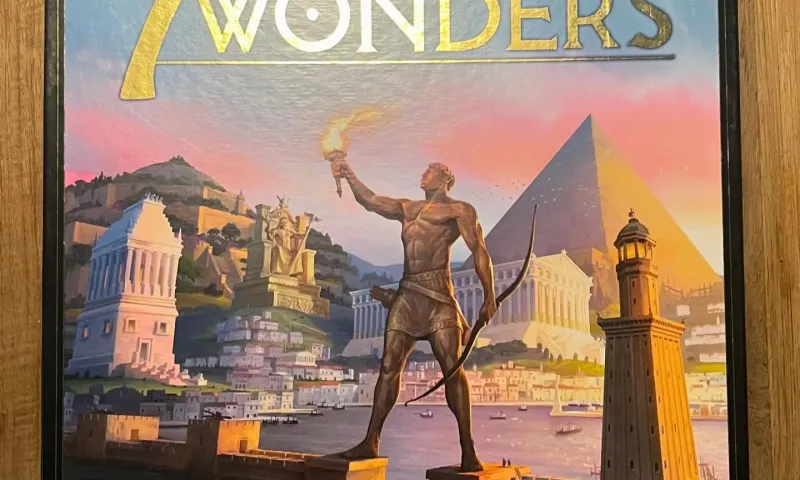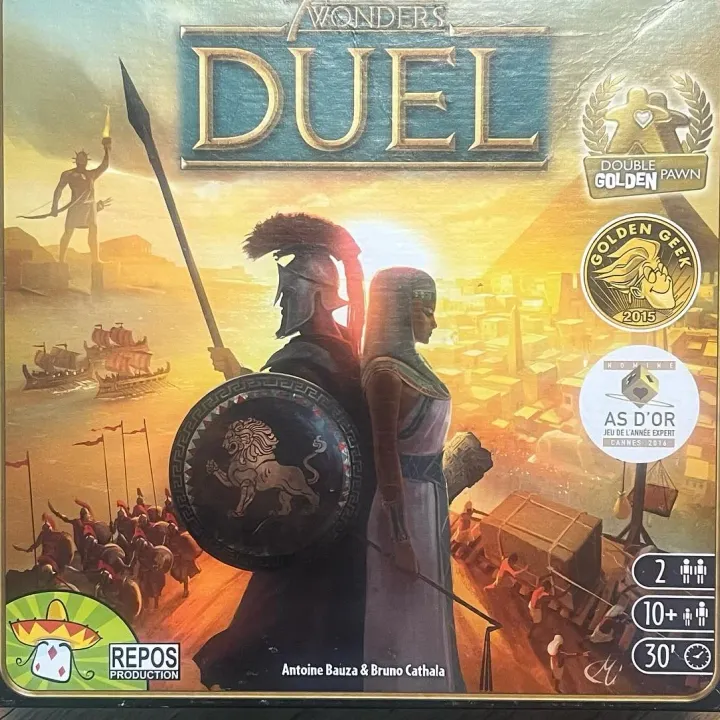
We liked 7 Wonders Duel so much that we went out and tried its big brother. The big brother is really good. The little one still wins.
7 Wonders Duel is one of our favorite games, period. It fits a whole civilization, three ways to win and a proper duel into about half an hour. If your table regularly seats exactly two, this is one of the first games I’d hand you.
What is 7 Wonders Duel?
You and your opponent each build an ancient civilization over three ages. You collect resources, put up buildings, train armies, chase science and construct wonders. It’s a spin-off of 7 Wonders, made especially for two players, by Antoine Bauza and Bruno Cathala, published by Repos Production.
The box says two players, about 30 minutes, 10+. It’s a 9 out of 10 for us. So is the Pantheon expansion, which we’ll get to.
How it plays
The clever bit is how the cards come out. Each age, the cards are laid out on the table in a set pattern, with some face-up and some face-down. You can only take a card that isn’t covered by another one. Every card you take might uncover something great for your opponent. Or something great for you, two turns from now.
On your turn you take one card and do one of three things with it:
- Build it. Pay its cost, add it to your city.
- Build a wonder. Tuck the card under one of your wonders to complete it.
- Sell it. Discard it for coins.
If you’re missing a resource, you buy it from the bank, and it gets more expensive the more of that resource your opponent produces. So your opponent’s city literally raises your prices. It’s a small rule with a big bite.
And there are three ways to win:
- Military. Push the conflict pawn all the way into your opponent’s capital.
- Science. Collect six different science symbols.
- Civilian. If nobody wins early, the most points after the third age take it.
Why it’s still on top
It’s quick, beautiful and strategic. That’s how we described the big 7 Wonders after we finally tried it. Every word applies to Duel too. The difference is that Duel turns all of it into a proper fight.
You never get to relax. With three paths to victory, you can’t just build your own thing and hope for the best. If your opponent drifts toward science, you have to react. If the conflict pawn creeps toward your capital, you have to react. Ignore one path and it’ll usually cost you. We hear that a lot in the community, too.
We keep coming back. We call ourselves huge fans, and we mean it. It came to the table again as “one of our favorite games”, it was on our list, and when the Lord of the Rings version came out, we were excited precisely because of Duel.
7 Wonders or 7 Wonders Duel?
We tried the big 7 Wonders precisely because we’re such big fans of Duel. Here’s how they compare for us.
| 7 Wonders | 7 Wonders Duel | |
|---|---|---|
| Our take | really good: quick, beautifully designed, strategic | our favorite of the two |
| Feel | broader, more variety | direct strikes, denial and timing |
7 Wonders
- Our take
- really good: quick, beautifully designed, strategic
- Feel
- broader, more variety
7 Wonders Duel
- Our take
- our favorite of the two
- Feel
- direct strikes, denial and timing
Duel trades some of the original’s breadth for tension and interaction. We hear that a lot in the community, too. If you mostly play with two, start with Duel. If your group is bigger, Duel can’t help you, and the original can.
The Lord of the Rings version
At SPIEL in Essen we picked up The Lord of the Rings: Duel for Middle-earth and played it for the first time. It’s by the same designers and publisher, and at its core it’s a re-imagining of 7 Wonders Duel.
It’s a lot of fun, and the new mechanics bring a fresh twist. But so far, every round we’ve played has been won via the Middle-earth map card. Maybe a bit overpowered? We’ll see how that evolves in future games.
The Pantheon expansion
We own Pantheon and give it the same 9 out of 10 as the base game. It adds gods from five mythologies, a Pantheon board above the main board, new wonders and Grand Temples in the last age. You choose which gods become available in the first age, then invoke them later by paying gold.
We recommend it highly, but only once you know the base game well. It isn’t a must-have. So: learn Duel first, then add the gods.
Where it stings
It’s two players only. Not two to four, not “best with two”. Two. If you’re a family of four, this is a game for pairs within the family, not for game night with everyone.
The symbols take a minute. Teaching it is no harder than the original, but the iconography still needs explaining. And face-down cards can swing a game in a way that feels a little unfair when it’s not in your favor.
7 Wonders Duel with kids
The box says 10+. Our older daughter was already into 7 Wonders Duel at 8, alongside Wingspan and Everdell. That’s two years under the box.
You often hear that many 7-year-olds who can read manage it if you help with strategy in the first few games. That matches the shape of the game: the rules are small, the thinking is big. Since it’s strictly two players, it suits any pair in families of all kinds: a parent and a kid, a grandparent and a grandkid, or siblings once the younger one is ready.
What we hear in the community
Most people agree: it was built for two from scratch, not squeezed down from a bigger game, and blocking your opponent matters as much as building your own city. Many count it among the best pure two-player games around, smart and brisk. The rulebook and player aid get a lot of praise, and once both players know the game, a match is often over in 20 to 25 minutes.
The criticisms: some wonders, especially those that give an extra turn, feel stronger than others, and turns can bog down when someone over-thinks. Some feel the streamlining costs a bit of depth and variety compared with the original. And a few wish the cards were bigger.
Our verdict
If two is your usual number, whether you’re a couple, a parent with an older kid or two roommates, 7 Wonders Duel belongs on your shelf. It’s quick, it’s tense, and it never lets you stop paying attention.
If you need a game for three or more, get the big 7 Wonders instead. It’s really good. It just isn’t Duel.

Where it shines
- Quick, beautifully designed and strategic in about 30 minutes
- Three ways to win, so you never stop watching your opponent
- Built for two from scratch, not a squeezed-down big game
- Our older daughter was already a fan at 8

Where it stings
- Two players only, full stop
- Face-down cards can swing a game
- Lots of symbols to learn before the first game clicks
Fact sheet
- 2
- about 30 min (box)
- 10+
- Antoine Bauza, Bruno Cathala
- 9/10 (Pantheon expansion: 9/10)
From our table
FAQ
Is 7 Wonders Duel better than 7 Wonders?
For us, yes. We tried the big 7 Wonders because we love Duel so much, and it's really good: quick, beautifully designed and strategic. But Duel still holds the top spot for us.
How long does 7 Wonders Duel take?
The box says about 30 minutes. Once both players know the game, it's often done in 20 to 25.
Can kids play 7 Wonders Duel?
The box says 10+. Our older daughter was already a fan at 8. Expect to help with strategy in the first games.
Is the Pantheon expansion worth it?
We own it and rate it as highly as the base game. For us it's a great addition once you know the base game, but not essential.
7 Wonders Duel or The Lord of the Rings: Duel for Middle-earth?
Duel for Middle-earth is a lot of fun and its new mechanics bring a fresh twist. In our first games, though, every round was won via the Middle-earth map card, which felt a bit overpowered. We need more games before we pick a winner.