Who looks at a trick-taking game, the stuff of grandparents and rainy holidays, and thinks: let’s build a space war on that? Cole Wehrle, apparently. And the result blew us away.
The first time we played Arcs, we were hooked. That hasn’t changed: it keeps coming back to our table, and we still love it. Arcs mixes strategic depth with fast-paced action and player interaction that never lets up. It’s a space war disguised as a card game, with stunning artwork on top.
What is Arcs?
Arcs is a game of conflict in space for two to four players. You build fleets, conquer planets, gather resources and try to outdo everyone else, all driven by a deck of cards that decides what you can actually do each turn.
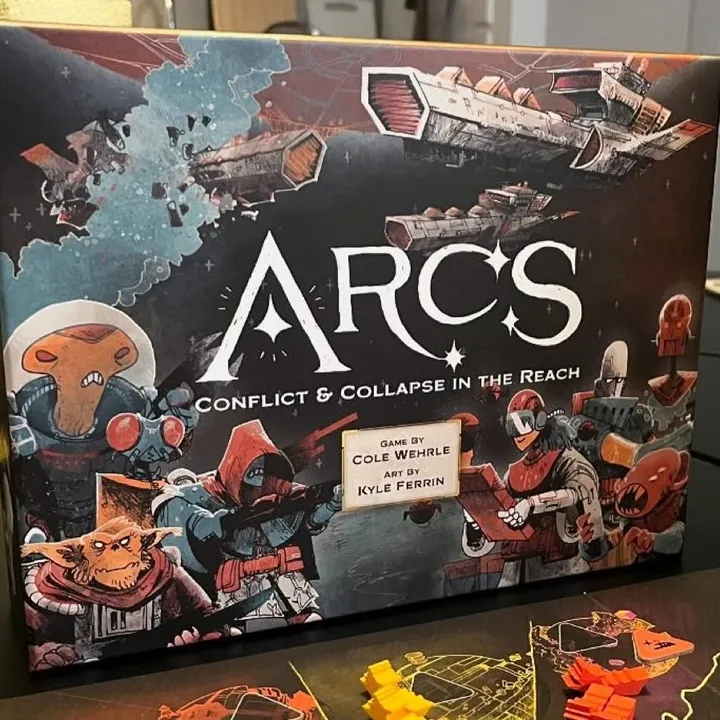
Its full title is Arcs: Conflict & Collapse in the Reach. It was designed by Cole Wehrle, the designer behind Root and Oath, illustrated by Kyle Ferrin and published by Leder Games. Kickstarter backers got it first, and it hit retail on October 1, 2024.
We’ve played it with two, three and four. All of them work, but three is the sweet spot for us. A game takes us about 90 minutes. Published play times are all over the place, from 60 to 120 minutes to two or three hours, so treat any number as a rough guide. The explanation takes a while, and the first few turns are clumsy until everyone gets the rhythm. After that, it flows.
How it plays
A game runs over five rounds. Each round is built around cards, ambitions and a lot of jostling for position.
- Action cards, played as tricks. One player leads a card, the others follow. The card you play decides which actions you get.
- Ambitions. Scoring isn’t fixed. Players declare what will be worth points this round, so the goals shift from round to round.
- Ships, court cards and dice. You move fleets, compete over court cards and settle fights with dice. And there’s more than one kind of combat die.
That’s the skeleton. Here’s what it feels like at our table.
Trick-taking, but make it war
The core mechanic is trick-taking. You play a card, the others follow, and the highest card in suit wins the initiative. Sounds harmless. It isn’t.
Timing is everything. One wrong card can set you back badly, while the right one at the right moment hands you a big advantage.
Nowhere to hide
What makes Arcs stand out is the constant interaction. Whether you’re conquering planets, building fleets or launching attacks, every decision lands on somebody else’s plans. That keeps the tension high from the first turn to the last.
In Arcs, you can never just sit back and watch. Believe me, you won’t want to.
Ambitions: say it out loud, then try to deliver
Another highlight is the ambition system. At the start of each round, you declare your goals. Then you have to actually achieve them while everyone else competes for the same resources, territories and targets. Easier said than done.
It’s a lovely piece of design. It gives the game a strong strategic spine and keeps everybody busy outmaneuvering each other.
Resources and dice
Resources are tight, so you’re constantly balancing expansion against defense. In combat, the different dice add a satisfying risk-reward choice: you decide how much you’re willing to gamble.
The catch: luck has a vote
There’s some luck in the card draws and dice rolls, and sometimes it limits what you can do. You plan beautifully, and then the deck shrugs. Overall, though, the unpredictability keeps the game exciting and fresh, so we’ve made our peace with it.
Arcs, Root or a big space epic?
If you’re shopping around, these are the games Arcs gets compared to most. This is what we hear in the community, not our own head-to-head.
| How it compares to Arcs | |
|---|---|
| Root (also by Cole Wehrle) | Shares the swinginess, the interaction and the learning curve. Arcs is considered easier to teach |
| Twilight Imperium, Eclipse | Arcs is faster and more tactical, with a thinner economy. It doesn’t replace a long empire builder |
| Arcs: The Blighted Reach | The campaign expansion: three sessions, about six hours in total, and you need the base game. We haven’t played it. |
There’s also a Leaders and Lore pack that adds asymmetric leaders. We can’t tell you much about it. An order you hear a lot: base game first, then Leaders and Lore, then the campaign.
Arcs with kids
The box says 14+. Would we play it with our 10-year-old? Absolutely. Arcs isn’t overly complex, but it is quite confrontational. If your kid enjoys direct conflict at the table, it can work well. If conflict at the table tends to end in tears, give it a year or two.
To be fair, we’re out on a limb here. We didn’t find anyone else who recommends Arcs for kids under 14. A few things are worth knowing before you try:
- Conflict is the point. Fighting can’t be avoided, and passive play doesn’t work. Someone will lose planets. Possibly a 10-year-old.
- There’s reading. The cards are fairly text-heavy. A confident reader will have a much easier time.
- The first games are bumpy. We felt the clumsy first turns ourselves. Choice paralysis and a steep start for casual players come up a lot in the community, too.
- There’s no official kids’ version. We didn’t find any simplified rules.
What we hear in the community
A lot of what we love, we keep hearing in the community, too: the unusual trick-taking that decides what you can do each turn, the strong interaction, and a space-conquest feel in a much shorter game than the classic space epics. Many players also like the variety from shifting ambitions and setups, and some argue that the luck of the deal is exactly what creates the stories and the drama.
The criticisms match ours as well: luck in the card deal, a game that rewards reacting more than long-term planning, and conflict you can’t avoid. Opinions on two players differ: some find it weaker than three or four.
The Blighted Reach campaign gets praise for the rich story it builds over three games. Some also find its rules murky in edge cases or the campaign restrictive. The common advice: learn the base game first.
Our verdict
Arcs lives up to the hype, and it keeps earning its place on our table. If you enjoy tactical, confrontational games and like your strategy with a side of chaos, get three friends (or two) and give it a try. Roommates who enjoy a good grudge, siblings who’ve been rivals since birth, a chosen family that likes its game nights loud: welcome to the Reach.
If you prefer games where everyone quietly builds their own thing, Arcs is not your friend. It will come for your planets.

Where it shines
- Constant interaction: nobody gets to sit back
- Ambitions add real strategic depth
- Trick-taking for initiative makes timing everything
- Tight resources force hard choices between expansion and defense
- Different combat dice let you pick your own level of risk
- Works at two to four, sings at three
- Kyle Ferrin's artwork

Where it stings
- Card draws and dice can quietly sabotage your plans
- The rules explanation takes a while, and so do the first clumsy turns
- It's confrontational by design, so conflict-averse players will suffer
Fact sheet
- 2–4 (best with 3 for us)
- about 90 min (our games), plus rules explanation
- 14+
- Cole Wehrle / Kyle Ferrin
- Leder Games
- 9/10
From our table
FAQ
How does Arcs work?
The core mechanic is trick-taking: you play cards, and the highest card in suit wins the initiative. Each round you also declare ambitions and compete for resources, territories and fights.
What is the best player count for Arcs?
We've played Arcs with two, three and four players. For us, three is perfect.
How long does Arcs take?
Our games take about 90 minutes. The first game takes longer, because explaining the rules and getting the first turns to run smoothly takes a while.
Can a 10-year-old play Arcs?
We'd play it with our 10-year-old. Arcs isn't overly complex, but it is quite confrontational, so it depends on whether your kid enjoys direct conflict. The box says 14+.
Is there a lot of luck in Arcs?
There's some luck in card draws and dice rolls, which can sometimes limit your strategy. For us, the unpredictability also keeps the game exciting.
Is Arcs like Root?
Both are by Cole Wehrle and share a lot of interaction and swinginess. In the community, you often hear that Arcs is easier to teach than Root.
Do you need The Blighted Reach expansion?
No. The Blighted Reach turns Arcs into a campaign over three sessions and needs the base game. We haven't played it. The usual advice in the community is to learn the base game first.
Is Arcs a good two-player game?
It works with two for us, but three is our favorite. Opinions differ: some find two players weaker, others find two-player games especially heated.