We had just started Magic and were completely buried under all the editions and boxes. And we didn't even want to collect. We wanted to play. Then I came across Mindbug through its King of Tokyo edition, and the problem was solved.
Mindbug is a card duel for two. One of its designers is Richard Garfield, who created Magic, and it feels exactly like the Magic we had wished for: fast, tactical, and complete in one box. By now we have four boxes on the shelf. Here's what sets them apart, and where we'd start.
The quick answer
- New to Mindbug? Get the base set, First Contact. Fewest rules, clearest game.
- King of Tokyo fans? Mindbug x King of Tokyo will win you over with the theme. Just expect the dice to matter less than the box promises.
- You know the base set and want more back-and-forth? Beyond Evolution.
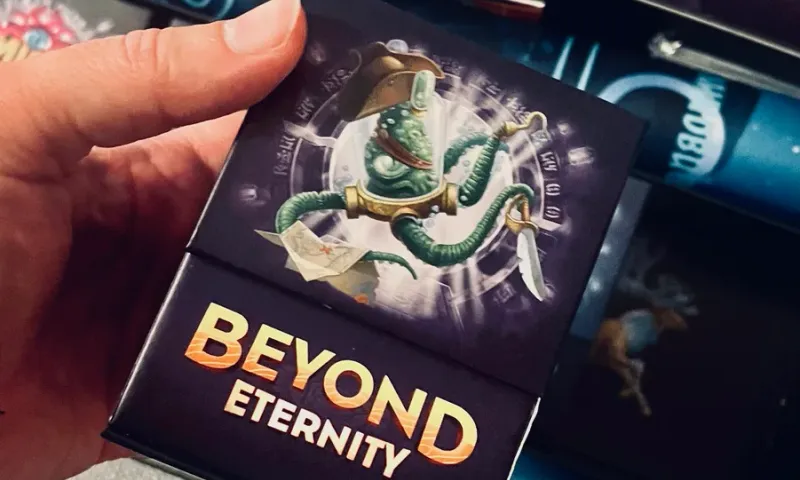
- You like it confrontational and enjoy building up before you strike? Beyond Eternity.
How Mindbug works
Each player has ten creatures, five in hand, and three lives. On your turn you do exactly one thing: play a creature or attack with one. The defender may block, and the weaker creature is defeated. No block means losing a life.
And then there are the Mindbugs. Each player has exactly two. When your opponent plays a creature, you can spend a Mindbug and take that creature right away, effect and all. In return, they get an extra turn. Once a Mindbug is gone, it’s gone.
On top of that come five basic keywords you have to learn once: Frenzy (attack twice), Hunter (you choose the blocker), Poisonous (defeats any enemy in combat), Sneaky (can only be blocked by sneaky creatures) and Tough (survives once).
Stealing is the whole game
On paper it’s a small rule. At the table it’s a poker game.
Do you play your best card early? Then someone might steal it. Or they won’t, because they think something even stronger is coming. So you’d rather put down a good, but not your best, card as bait, so the Mindbugs get spent on it. And if you build your whole plan around one card, you’ll see exactly that card on the other side of the table. It hurts. And it’s brilliant.
At our table, I play against my daughter. She loves sneaky creatures, I love hunters. I know she’ll snatch every sneaky creature I play. So I have to figure out how to deal with that, and only unpack my real plan once her Mindbugs are gone. She, in turn, knows exactly when I’ll steal which card. Honestly, she wins a lot.
How Mindbug landed on our table
We’re King of Tokyo fans, so our first box was Mindbug x King of Tokyo. My daughter and I played; she was nine at the time. The first game was a little disappointing: the dice we know from King of Tokyo only play a supporting role here. After two or three games we understood the cards and the actions, and then it was clear: this is exactly our game. She picked it up faster than I did, by the way.
After that, we got the other three in one go: the base set, Beyond Evolution and Beyond Eternity, together in one big box with a playmat.
Mindbug is a father-daughter thing for us. We play it in between, right before bedtime, and on the road. A game is over quickly, so it’s often two. My wife rarely joins. She prefers Agent Avenue, another two-player game from the same publisher.
The four boxes compared
| First Contact | Beyond Evolution | Beyond Eternity | Mindbug x King of Tokyo | |
|---|---|---|---|---|
| What it is | the base game | standalone expansion | standalone expansion | standalone set |
| Released | Kickstarter 2021, retail 2022 | 2023 | 2023 | October 2025 |
| New | – | Actions as a third turn option, creatures that evolve in three stages | “Boost” from the discard pile, abilities that work from the discard pile | creatures roll dice when attacking, energy, a market of Power cards |
| Feel | clear, quick to learn | more interaction, more swings | the most confrontational for us, close to the base game for some | more luck, a bit more upkeep |
| Players, time, age | 2, 15–25 min, 8+ | 2, 15–25 min, 8+ | 2, 15–25 min, 8+ | 2, 15–25 min, 8+ |
First Contact
- What it is
- the base game
- Released
- Kickstarter 2021, retail 2022
- New
- –
- Feel
- clear, quick to learn
- Players, time, age
- 2, 15–25 min, 8+
Beyond Evolution
- What it is
- standalone expansion
- Released
- 2023
- New
- Actions as a third turn option, creatures that evolve in three stages
- Feel
- more interaction, more swings
- Players, time, age
- 2, 15–25 min, 8+
Beyond Eternity
- What it is
- standalone expansion
- Released
- 2023
- New
- “Boost” from the discard pile, abilities that work from the discard pile
- Feel
- the most confrontational for us, close to the base game for some
- Players, time, age
- 2, 15–25 min, 8+
Mindbug x King of Tokyo
- What it is
- standalone set
- Released
- October 2025
- New
- creatures roll dice when attacking, energy, a market of Power cards
- Feel
- more luck, a bit more upkeep
- Players, time, age
- 2, 15–25 min, 8+
The base set was on the 2023 Kennerspiel des Jahres recommendation list.
Our reviews: First Contact, Beyond Evolution, Beyond Eternity and Mindbug x King of Tokyo.
To mix or not to mix?
All four boxes can be combined. We still don’t. Every box brings its own mechanics that change the game noticeably, and that’s exactly the appeal. And the King of Tokyo box in particular is balanced as a unit, so I’d be extra careful mixing it.
Where it stings
- The keywords. Frenzy, Hunter, Sneaky, “in discard pile”: you have to understand them once. They’re quick to explain, though, and after a few games you know your deck.
- The luck of the draw. A weak hand happens. It’s rarely really weak, though. Most of the time you just play the plan your cards give you.
- The dice in King of Tokyo. If you buy it for the dice, you might be disappointed at first. We were.
What we hear in the community
The criticism partly matches ours. Some find the base game a bit swingy over time. For Beyond Evolution, the counterplay is seen as less forgiving, with a few tough creatures that are hard to get rid of. For the King of Tokyo box, the luck of a weak starting hand is felt as harsh. And for younger kids, all the abilities can be a lot.
On which box to start with, almost everyone recommends First Contact. A few say you can start with any box, and some even recommend Beyond Evolution to newcomers. On mixing, there are three camps: everything in one stack, each box on its own (like us), or a custom pool with the too-strong cards taken out. The card that gets cut most often is Giraffodile from the base set. Our advice is relaxed: if a card ruins the fun for you, take it out. And the ranking of the boxes? Nobody agrees, every box has its fans. Same as at our table.
Our verdict
Mindbug is the card game we had wished Magic would be: short, always intense, and after every game you can say exactly what went well or badly. You find your favorite cards fast, and every box plays differently.
Our advice: start with the base set. If it grabs you, the other boxes aren’t a collecting habit, just new duels. If you like two-player games, have a look at King of Tokyo Duel too.
From our table
FAQ
Which Mindbug box should I start with?
First Contact, the base set. It only has the five basic keywords and is the easiest to learn. We started with Mindbug x King of Tokyo ourselves, but today we'd start with the base set.
Can you mix the Mindbug boxes?
Yes: all four boxes are standalone and can be combined. We still don't mix them, because every box has its own character. Be careful with the King of Tokyo box, since it's balanced as a unit.
What age is Mindbug for?
Every box says 8+. Our daughter started at nine and picked it up faster than I did.
How long does a game of Mindbug take?
The publisher says 15 to 25 minutes. We often play a second one right after, because it's over so quickly.
Do you need to know Magic to play Mindbug?
No. Mindbug is co-designed by Richard Garfield, who created Magic, but every box is complete and playable without collecting or deck building.