The world is ending. Again. Catastrophes strike one after another, and all you can do is help your tiny species survive long enough to score some points before the final event wipes everything away. Welcome to Doomlings, the cutest apocalypse you’ll ever host.
We played a few rounds on the edge of extinction and had a blast. Then we got the expansion, Imaginary Ends, and spent even longer on it. More on that below.
What is Doomlings?
Doomlings is a card game for two to six players. Each card is a trait you add to your species: some are powerful, some are silly, many interact with each other. Meanwhile, the Ages deck moves the world toward its end, throwing catastrophes at everyone. When the final catastrophe hits, the game is over and you count up your traits.
It was designed by the brothers Justus and Andrew Meyer, with Justus also drawing the art, and published by Doomlings LLC in 2022. The publisher lists 20 to 45 minutes. With three players, a game takes us under 30 minutes. With six, it takes a bit longer, but it never feels drawn out.
How it plays
You can teach Doomlings in about five minutes. The flow is simple:
- Build a species. You play trait cards in front of you. Each one is worth points and carries effect text, and the fun is in finding traits that work together.
- Live through the Ages. The Ages deck pushes the world toward its doom and throws catastrophes at everyone.
- Count the catastrophes. When the third catastrophe appears, the world ends and everyone adds up their trait points.
- Mind the World’s End. Catastrophes and the final World’s End scoring can wreck a strong position right before the count.
In the 2022 edition, that’s 160 trait cards, 25 Ages, 15 catastrophes, 6 Gene Pool cards and one Birth of Life card. Small box, plenty of doom.
Chaos with a brain
What we love: the constant interaction. Everyone is fighting for survival, and every turn throws something unpredictable at you. But it’s not just random noise. In the middle of all that chaos, there are real tactical choices, and the short playtime hides more depth than you’d expect.
The design is charmingly cute and the card quality is top-notch. It looks and feels like a game that was made with love.
The catch: scoring
The scoring is not very intuitive and feels more complicated than it should be. There’s an online tool for it, but it doesn’t really solve the problem. A simple scoring pad in the box would have helped a lot.
Depending on your taste, you might also notice:
- With five or six players, the deck can run out quickly.
- There’s luck, and some mean actions like swapping or stealing cards. It’s not pure strategy.
- If you love long-term strategic planning, this won’t be your kind of game.
None of that ruins the fun for us. It just means you should know what you’re signing up for: a chaotic, quick game, not a puzzle.
Imaginary Ends: five expansions in one box
We love Doomlings, so we couldn’t wait for Imaginary Ends. And honestly, this review took way longer than planned, because you can’t just quickly test this box. One game per variant isn’t enough to get a feel for it, so we played through each of them several times.
The box came out in 2024 and contains five sets, each with its own rule card, so you can add them one at a time. Each brings its own mechanics, its own vibe and its own chaos:
| Set | What it adds |
|---|---|
| Magical Merchants | objective cards that score when you complete them, plus trinkets |
| Glitterlings | traits that run on chance |
| Moonlings | pass unwanted cards to opponents; a small gene pool pays off |
| Deeplings | a new “suppress” mechanic that turns traits face down |
| Fuzelings | a mix of the other sets, with bigger end-game bonuses and combos |
Our favorite: the Moonlings, the set where you get to pass unwanted cards to your opponents.
Is Imaginary Ends worth it? Yes, if you want more cards and more variety. It needs the base game.
Which Doomlings should you buy?
Doomlings has grown into a whole family of boxes, which can be a bit confusing. Right now, the publisher’s store lists a Remastered base game next to a Classic edition marked as “retiring soon,” plus bigger bundles with expansions and extras. We haven’t played the Remastered version, so we can’t tell you how much it changes.
Besides Imaginary Ends, there are other expansions such as Legends of Enderas, the random booster packs of Overlush and small sets like Shadow Puppets. We haven’t tried any of them. Our advice: start with the base game, and if it clicks, Imaginary Ends is the one we can vouch for.
And if you’re wondering how Doomlings compares to other chaotic card games, here’s how the community often places it:
| Game | Compared |
|---|---|
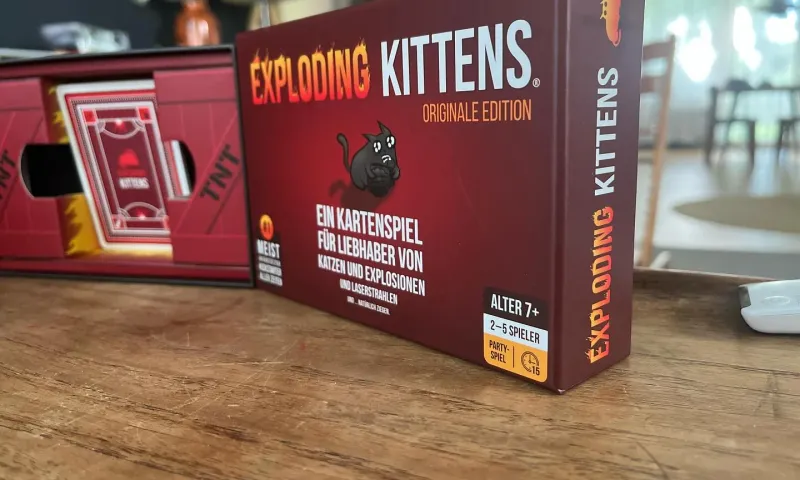
| Exploding Kittens | same light, chatty space; some find Doomlings more fun and Kittens thinner |
| Fluxx | Doomlings is more structured |
| Uno | Doomlings is a slightly meatier family game |
| Evolution | Doomlings is lighter |
Doomlings with kids?
Not at our house, at least not yet. You need to read the cards, and there’s a lot of text on them. On top of that, as far as we could find, Doomlings isn’t available in German, which makes it harder even for our 10-year-old. Our 6-year-old doesn’t play it. If your kids read English comfortably, it’s a different story.
The age on the box isn’t even consistent: the publisher’s store says 8+, while you’ll see 10+ elsewhere. Check the box of the edition you buy.
Other families have had good experiences. In the community, you hear about 8-year-olds enjoying it next to experienced players and families who play it often with their teenagers. And there’s nothing crude in it. Take those as leads from other tables, not our verdict.
What to watch for:
- Reading. Every trait has effect text. A kid who doesn’t read fluently, in English, will need a helper.
- Colors. The cards are sorted by colored borders, which can be hard for colorblind players.
- Swings. Some effects are mandatory and can hurt you, and the end of the world can turn the scores upside down. A kid who was winning all game may feel robbed.
What we hear in the community
People praise the quick teach, the cute art and the light, chatty feel. Reading the cards out loud is part of the fun, and it works well as a filler between heavier games. Because you can chat while you play, many find it a good fit for mixed and casual groups.
The common criticisms are heavy luck, catastrophes that can wreck a strong position, and decisions that are sometimes thin. Setup is a bit fiddly. Three or four players is often called the sweet spot, which matches our experience.
About Imaginary Ends, you hear that the variety and the rule cards that let you add sets gradually go down well, but also that it adds more randomness and bigger point swings.
Our verdict
If you enjoy games with humor, surprises and lively table dynamics, Doomlings is a great addition to your collection. It thrives on chaos and quick decisions, and every round is different. Roommates on a game night, a family with teens, friends who laugh at bad luck: this is your apocalypse.
If you want strategy you can plan, or your kids aren’t reading English yet, look elsewhere. And whatever you do, bring a pen and paper for the scoring.

Where it shines
- Constant interaction as everyone fights for survival
- Tactical choices in the middle of pure chaos
- Short playtime, but the game has depth
- Charmingly cute design and top-notch card quality
- Imaginary Ends adds five variants, each with its own vibe

Where it stings
- Scoring is unintuitive and more complicated than it should be
- With five or six players, the deck can run out quickly
- Luck and mean actions (swapping, stealing) mean it's not pure strategy
- Lots of English text and no German edition: hard for our kids
Fact sheet
- 2–6
- under 30 min with 3 players (our games); a bit longer with 6
- 8+ (publisher store); you'll often see 10+ too
- Justus Meyer, Andrew Meyer
- Doomlings LLC
- English only (no German edition)
- Imaginary Ends (favorite variant: Moonlings)
From our table
FAQ
Is Doomlings good for kids?
Only if they read English well. The cards have a lot of text, and there's no German edition, which makes it harder even for our 10-year-old. Our 6-year-old doesn't play it.
How long does Doomlings take?
With three players we finish in under 30 minutes. With six it takes a bit longer, but it never feels drawn out.
Is the Doomlings Imaginary Ends expansion worth it?
Yes, if you want more cards and variety. It contains five different variants, and each brings its own mechanics. Our favorite is the Moonlings.
Is Doomlings a strategy game?
Not really. There are tactical choices, but also a lot of luck and some mean actions like swapping or stealing cards. If you prefer strategic planning, it won't be your kind of game.
What's the best player count for Doomlings?
With three players our games are quick and lively. In the community, three or four is often called the sweet spot, and six gets slower. With five or six, the deck can also run out quickly.
Do you need the base game to play Imaginary Ends?
Yes. Imaginary Ends is an expansion and needs the Doomlings base game.
How does a game of Doomlings end?
When the third catastrophe hits, the world ends. Then everyone counts the points of the traits in their species.
We received this game as a free review copy.