Dragomino is the one kids’ game we actually enjoy playing too. I’m genuinely happy when my youngest asks for it.
It’s one of her absolute favorites, and we enjoy playing it with her. That’s a rare combination. Plenty of kids’ games feel like a favor you do your child. This one doesn’t: it’s easy to learn, quick to set up, and has just enough tactical depth to keep us grown-ups engaged without overwhelming her.
What is Dragomino?
Dragomino is the kids’ version of the domino-style tile-laying idea from Kingdomino. Each turn, you draft a landscape tile and place it in your own little land, matching colors to build larger regions. Every time you match a landscape, you get a dragon egg of that color. Flip it over: maybe there’s a baby dragon inside, maybe just an empty shell.
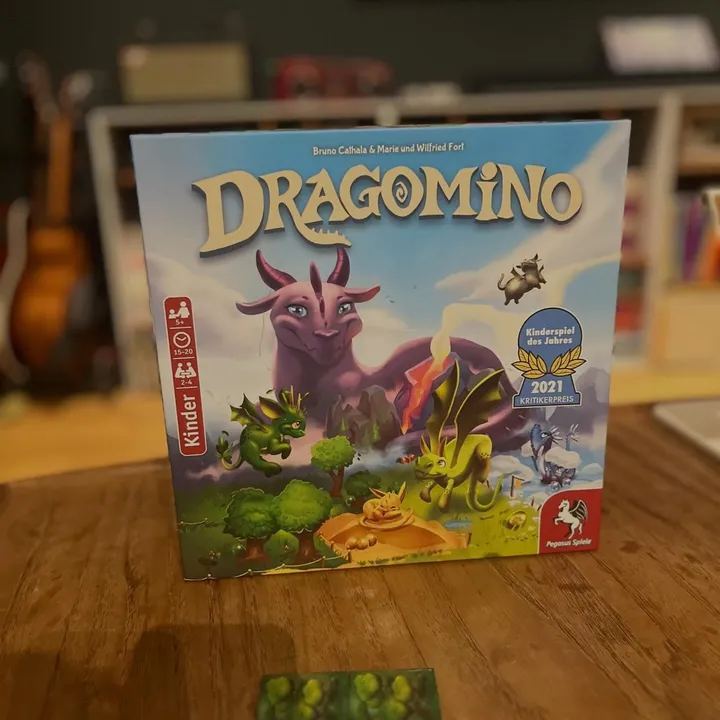
It’s designed by Bruno Cathala, Marie Fort and Wilfried Fort and published by Blue Orange Games. Our copy is the German edition from Pegasus Spiele. It came out in 2020 and won the Kinderspiel des Jahres, Germany’s children’s game of the year, in 2021.
The box says two to four players, age 5+ and 15 minutes. It’s easy to learn, quick to set up, and a game takes us about 20 minutes.
How it plays
If you know Kingdomino, you’ll feel at home in about thirty seconds. If you don’t, here’s the whole game.
- Same start for everyone. Each player begins with the same starting domino. Four dominoes lie face up in the middle. On your turn, you take one and attach it to your territory.
- Match a color, earn an egg. Every landscape edge that matches earns you an egg of that color. You flip it right away. A baby dragon is worth one point. An empty shell is worth nothing, but it hands you the Mommy Dragon, who decides who picks first next round.
- Not all eggs are equal. Some colors hide dragons more often than others: red volcano eggs are the best bet, yellow desert eggs the worst.
- No grid, no reading. Unlike Kingdomino, there’s no size limit for your land, and there’s nothing to read.
- The end. When all dominoes are placed, you count your dragons. Whoever holds the Mommy Dragon gets a bonus point, and ties go to the player with more shells.
In the box: 28 exploration dominoes, four starting dominoes, 69 egg tokens and one Mommy Dragon. That’s it. Setup is basically “shuffle and go.”
Simple, but meaningful
What I like as a grown-up: it’s a nice little puzzle. Every decision is simple, but meaningful. Which tile do you take? Where do you put it? Which colors do you go for? You match colors to grow bigger regions, and every match is a shot at another egg. That’s enough to keep grown-ups engaged, and never so much that a younger player gets lost.
The egg odds add one more quiet layer. A volcano match is a better bet than a desert match, so “which tile” is also a small gamble on dragons. Kids don’t need to know that to have fun. Grown-ups can play the odds.
The parent’s secret
Here’s the other thing I love: you can steer the game pretty well. If my youngest needs a win today, I can quietly make that happen. If she’s ready for a real challenge, I play for real. Not many kids’ games let you do that so smoothly.
It works because every turn is just “pick a tile, place a tile.” Taking the weaker tile or leaving a good match on the table doesn’t look like a gift. It just looks like a turn.
Dragomino or Kingdomino: which one?
Both games share the same core idea, so the real question is who’s sitting at your table.
| Dragomino | Kingdomino | |
|---|---|---|
| Your land | no size limit | a 5x5 grid you have to plan for |
| Scoring | baby dragons from eggs | crowns |
| Luck | egg flips and the Mommy Dragon | no egg luck |
| Box age | 5+ | older kids may prefer it |
Dragomino
- Your land
- no size limit
- Scoring
- baby dragons from eggs
- Luck
- egg flips and the Mommy Dragon
- Box age
- 5+
Kingdomino
- Your land
- a 5x5 grid you have to plan for
- Scoring
- crowns
- Luck
- no egg luck
- Box age
- older kids may prefer it
Our rule of thumb: if your youngest player is somewhere between four and seven, start with Dragomino. If everyone at the table can plan a few moves ahead, Kingdomino is the better fit.
Dragomino with kids
The box says 5+, but in our experience it’s super accessible and playable from about four or five. No reading needed, colorful tiles, and baby dragons. What more does a preschooler need? The core skill is matching colors, so about four works. We hear that a lot in the community, too.
Our 10-year-old rarely plays it anymore. When she does join, it’s mostly for the company.
A few things worth knowing before your first game:
- Two greens. Two of the landscapes are similar shades of green, which can confuse little ones.
- The Mommy Dragon swap. The first-player rule can be hard for small kids to track. For the youngest players, you can house-rule it away and start one-on-one.
- Coaching the eggs. Adults can help younger players figure out which egg colors are more likely to hide a dragon.
- A harder variant. There’s a variant called Dragon’s Thirst: on dominoes with a watering hole, you draw two eggs, keep one and put the other back face-down. It’s seen as a step toward Kingdomino for kids around eight or nine. We haven’t tried it yet.
And the honest limit: kids around eight or nine who already know board games may find it too simple.
What we hear in the community
Many players see Dragomino as a family game successfully turned into a children’s game: a good balance of luck and tactics, and kids feel confident after just one game. People love the dragon artwork, the rules that need no reading and the sturdy, glossy tiles. You also often hear that the luck of the eggs lets younger kids beat older players. Some compare it to Ticket to Ride: First Journey and find it clearly better than Candyland.
Common criticisms are thin strategy and a lot of luck, plus the two similar greens and the Mommy Dragon rule. And many say adults rarely play it without kids. Fair. With kids, though, we genuinely enjoy it.
When your kids are ready for more, the natural next step is Kingdomino, the grown-up version.
Our verdict
If you have kids between about four and seven, Dragomino is a great first “real” game. Fast, colorful and surprisingly strategic, and it works for all ages at the table. It’s the one kids’ game we actually enjoy playing too. A parent and a preschooler, grandparents with a grandkid on their lap, a big sibling showing a little one how it’s done: everyone gets a fair shot at the dragons.
If your kids are older, skip it and go straight to Kingdomino.

Where it shines
- Super accessible: playable from about 4 to 5
- Easy to learn and quick to set up
- Just enough tactical depth to keep adults engaged without overwhelming younger players
- Every decision is simple, but meaningful
- You can quietly steer whether the little ones win
- Our youngest's absolute favorite

Where it stings
- Our 10-year-old only joins now and then, and mostly for the company
Fact sheet
- 2–4
- about 20 min (our games)
- 5+ (works from about 4–5 for us)
- Bruno Cathala, Marie Fort, Wilfried Fort
- Blue Orange Games (German edition: Pegasus Spiele)
- Kinderspiel des Jahres 2021
- Our youngest
From our table
FAQ
What age is Dragomino for?
The box says 5+. In our experience it's super accessible and playable from about 4 to 5.
How long does Dragomino take?
About 20 minutes for us.
Is Dragomino fun for adults?
Yes. It has just enough tactical depth to keep adults engaged without overwhelming younger players. It's a nice little puzzle, and you can quietly steer whether the little ones win or not.
Is Dragomino a good game for the whole family?
With younger kids, yes. It's fast, colorful and surprisingly strategic, and it works for all ages at the table. Kids who are eight or older and already know board games may find it too simple on its own, though.
What's the difference between Dragomino and Kingdomino?
Dragomino is the kids' version of Kingdomino's domino tile-laying idea. Instead of scoring crowns, you collect dragon eggs that may hatch a baby dragon.
Do kids need to read to play Dragomino?
No. There's nothing to read during the game. You match colors, flip eggs and count baby dragons.
Is there a harder way to play Dragomino?
Yes. A variant called Dragon's Thirst lets you draw two eggs on dominoes with a watering hole, keep one and put the other back face-down. We haven't tried it yet.
How many players can play Dragomino?
Two to four.