Plenty of kids’ games are something parents sit through. Karak is one the adults at our table genuinely enjoy too.
Our youngest played her first dungeon crawler at four, and it was Karak. Watching her excitement, and how she started thinking strategically, was one of the sweetest board game moments we’ve had. She’s six now, and it’s still on our table.
What is Karak?
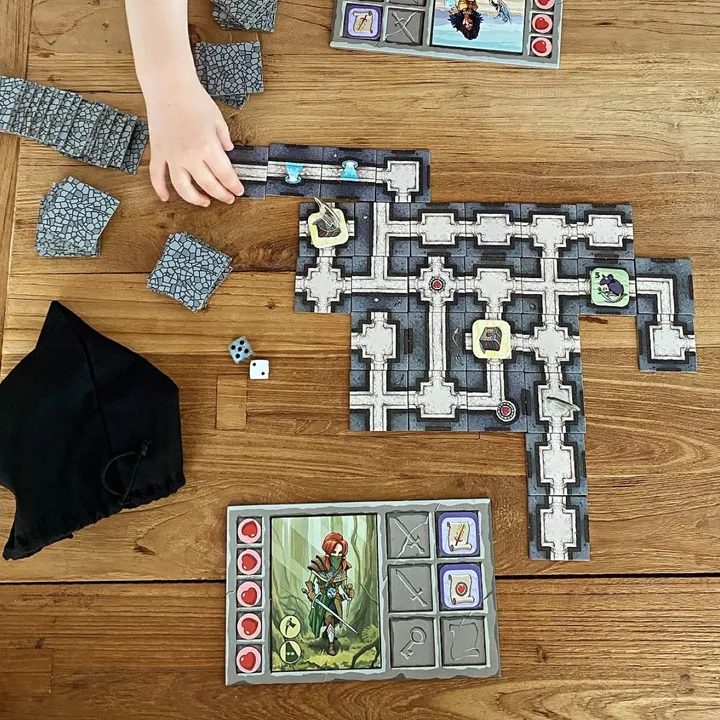
Karak is a dungeon crawler for kids. You pick a hero, explore a dungeon that you build tile by tile as you go, fight monsters and collect treasure. Somewhere in there waits the dragon.
It’s by Petr Mikša and Roman Hladík and was first published by Albi in the Czech Republic in 2017. It was named Czech Children’s Game of the Year in 2018, and Kosmos brought out the German edition in 2021. In English-speaking shops you’ll also see it as Catacombs of Karak.
The box details: two to five players, age 7+. The distributor lists 31 to 45 minutes. A game takes us about 30 minutes, often a lot less.
How it plays
The rules are simple, the pace is fast, and every turn feels like an adventure. Kids get all the excitement of a classic dungeon crawler (exploring new tiles, fighting monsters, grabbing loot) without the complexity. Here’s what’s going on under the hood.
- The dungeon grows as you go. There’s no fixed board. You draw random tiles and lay them out as you explore, so the dungeon is different every game.
- Combat is one simple sum. Roll the dice, add your gear, compare the total with the monster.
- Six heroes, six personalities. The box has six heroes, each with their own ability.
- Loot you can see. The layered player boards hold your weapons and items in place, so nothing slides around.
- Almost nothing to read. The game itself is text-free. The only real reading is the heroes’ abilities.
And there’s no game master. Nobody has to sit out and run the monsters. The dungeon does that job by itself.
The rare kids’ game adults enjoy
What we love most: Karak keeps adults entertained too. There’s enough strategy to make every game feel fresh, while it stays accessible for younger players. That’s rare. It’s one of those kids’ games that truly works for the whole family, and in my eyes one of the best-made kids’ games out there that adults also find interesting.
The gift that keeps working
Karak has become our go-to present for other kids who like the theme. Heroes, monsters, treasure: if that sparks something in a child, Karak delivers. So far, hardly any kid we’ve given it to hasn’t liked it.
The catch: it has an expiry date
There’s very little I’d criticize about Karak. The only real limit is age. At around eight, kids start to grow out of it, and it gets a bit too boring for them.
You can see that at our table. Our 10-year-old still joins sometimes, but only because she likes the company, not because of the game. For older kids, there’s Karak II, which is clearly meant for them. We picked up our copy at Berlin Brettspiel Con. More on that in a separate review.
Karak, Karak II or an expansion?
The Karak family has grown, and the boxes look alike. Here’s the quick overview.
| Karak | Karak II | Karak: Regent | Karak: New Heroes | |
|---|---|---|---|---|
| What it is | the original | standalone sequel | expansion | small add-on |
| Needs the original? | no | no | yes | yes |
| Players | 2–5 | 2–5 | ||
| Age (box) | 7+ | 10+ | ||
| Play time | about 30 min in our games | roughly 45–90 min (listed) | ||
| What’s in it | six heroes, random dungeon tiles | more engine-building | new heroes, tiles, monsters, a Lord of Karak mode | three new heroes |
Karak
- What it is
- the original
- Needs the original?
- no
- Players
- 2–5
- Age (box)
- 7+
- Play time
- about 30 min in our games
- What’s in it
- six heroes, random dungeon tiles
Karak II
- What it is
- standalone sequel
- Needs the original?
- no
- Players
- 2–5
- Age (box)
- 10+
- Play time
- roughly 45–90 min (listed)
- What’s in it
- more engine-building
Karak: Regent
- What it is
- expansion
- Needs the original?
- yes
- Players
- –
- Age (box)
- –
- Play time
- –
- What’s in it
- new heroes, tiles, monsters, a Lord of Karak mode
Karak: New Heroes
- What it is
- small add-on
- Needs the original?
- yes
- Players
- –
- Age (box)
- –
- Play time
- –
- What’s in it
- three new heroes
We haven’t tried either expansion.
Our rule of thumb: for kids between about four and eight, start with the original. For kids around ten, Karak II is the one that fits. There’s also Karak: Goblin, but that’s a deck-builder set in the same world, not a dungeon game, so it’s not a substitute.
Karak with young kids
Our experience: four worked for us, and around eight the magic starts to fade. The box says 7+, so we started well below that, and it worked.
Other families report the same lower end. In the community, you often hear about six-year-olds playing happily, and that kids under seven manage fine with an adult’s help. Pre-readers are fine: a grown-up can explain the hero abilities.
What about scary? The monsters include skeletons, mummies and a dragon, but the tone is lighthearted, with low tension.
A few things that come up in the community a lot:
- Loose tiles. The dungeon sprawls, and the tiles are easy to bump at a busy table.
- Close scores. Small score margins can frustrate kids.
- Long tail. Games can drag with more players if the dragon tile stays in the bag.
And if your table mixes ages, whether that’s siblings with a few years between them, cousins at a holiday table or a grandparent with a grandkid, here’s how it looks at ours: the youngest plays for the adventure, the oldest for the company. Both count.
What we hear in the community
Lots of parents see it the same way we do: the rules are very easy, and kids pick it up in minutes. You hear about six-year-olds who learned it quickly and kids who played it again on their own the same day. The simple combat gets praise, as do the sturdy components and the variety from random tiles and six different heroes.
The common criticisms: it’s luck-heavy, it’s thin for experienced players, and the sprawling dungeon tiles are easy to bump. Some find the weapons are basically just numbers, which adults may find tedious. And there are six heroes, but only five seats at the table.
Many see it as a bridge toward role-playing games and bigger dungeon crawlers, for example for kids who are curious about Gloomhaven. CoraQuest, Tiny Epic Dungeons, Starcadia Quest and The Quest Kids often come up as similar picks. We haven’t played those.
Our verdict
If you have kids between about four and eight who light up at the words “dragon” and “treasure”, get Karak. It’s one of the best kids’ games we know, and you’ll enjoy it too.
If your kids are older, skip straight to Karak II. And if you need a present for a young adventurer: this is it.

Where it shines
- Simple rules, fast pace, and every turn feels like an adventure
- All the dungeon-crawler excitement without the complexity
- Enough strategy to keep adults entertained
- Our youngest played it at four
- A gift that almost every kid we've given it to has loved

Where it stings
- Kids outgrow it at around eight, when it starts to feel a bit boring
- Our older daughter only joins for the company, not for the game
Fact sheet
- 2–5
- about 30 min (our games), often quicker
- 7+ (our youngest started at 4)
- Albi (German edition: Kosmos)
- Our whole family; our youngest since age 4
From our table
FAQ
What age is Karak for?
Our youngest played her first game at four. In our experience, kids outgrow it at around eight, when it gets a bit too simple. The box age listed by publishers is 7+.
How long does a game of Karak take?
About 30 minutes for us, sometimes a lot quicker.
Is Karak fun for adults too?
Yes. There's enough strategy to keep adults entertained while it stays accessible for younger players. It's one of the rare kids' games that truly works for the whole family.
Karak or Karak II: which should I buy first?
It depends on the age of your kids. Karak is for younger kids; Karak II is clearly meant for older children.
Is Karak a good gift for kids?
We regularly give it to other kids who like the theme, and so far hardly any child hasn't liked it.
Do kids need to read to play Karak?
Hardly. The only real reading is the heroes' special abilities, and a grown-up can explain those in a minute.
Is Karak too scary for young kids?
The monsters include skeletons, mummies and a dragon, but the tone stays lighthearted, with low tension. Our youngest started at four.
Are there expansions for Karak?
Yes. Karak: Regent adds new heroes, tiles, monsters and a mode where one player is the Lord of Karak. Karak: New Heroes is a small add-on with three heroes. Both need the base game. We haven't tried either.