Every parenting guide explains how kids learn to lose. Hardly any mention what blows up at our table just as often: winning. When our older daughter is ahead, gloating tends to show up faster than any good intention.
We looked at what research actually says about losing and winning. The result: 8 tips. For each one, we're honest about how well it's backed. Spoiler: less well than most parenting advice sounds.
The quick answer
- The uncomfortable truth: No tip for learning to lose is as well proven as guides like to suggest. A lot of it is expert opinion.
- What makes the most sense: help openly, shrink the help, name the feeling, lose well yourself.
- The overrated classic: "Praise effort, not intelligence." Later studies found much weaker effects.
- The underrated point: winning well. At our table, that's often the bigger problem.
How to read the traffic light
- 🟢 Studies: There’s research directly on it or very close.
- 🟡 Hints and experts: indirect studies or expert opinion.
- 🔵 Our table: our own experience, not science.
1. Help openly instead of secretly losing 🟡
A head start, bonus points or help everyone knows about is more honest than a deliberately bad move. Experts recommend it almost unanimously. A lab study offers an indirect hint: five- to seven-year-olds who had just been lied to by an adult stranger cheated more often afterwards (Hays & Carver, 2014). Secretly losing isn’t a lie in the strict sense, but it points in a similar direction.
When we still go easy now and then is in our article Should you let your kids win?
2. Shrink the help over time 🟢
Developmental psychologists call it scaffolding: as much help as needed, and less as soon as the child can manage alone (Wood, Bruner & Ross, 1976). The concept is very well established in education. For board games, that means the little one’s head start gets a bit smaller every game, so she can see she’s getting better.
3. Feelings first, solutions second 🟡
After a loss, it helps to name the feeling before talking about solutions: “You’re disappointed, and that’s okay.” That’s the idea behind emotion coaching (Gottman, Katz & Hooven, 1996). Studies link it to better self-regulation, but the findings are mixed and partly depend on culture.
4. Praise effort, but don’t expect miracles 🟡
The classic: kids praised for being smart held up worse after a failure in the lab than kids praised for their effort (Mueller & Dweck, 1998). A later, large study found much weaker effects (Li & Bates, 2019). Our take: “You really thought that through” certainly doesn’t hurt. It’s just not a miracle cure for tears.
5. Lose well yourself, and let them see it 🟡
Kids pick up how adults deal with setbacks. In a lab study, even babies made more attempts at a hard task after watching an adult visibly struggle and persist (Leonard, Lee & Schulz, 2017). That’s an experiment with very young children, not a board game. The direction still fits: think out loud, be allowed to be annoyed, congratulate, keep playing.
6. Winning well is a goal, too 🔵
We found no study on this, but plenty of our own experience. For our older daughter, not gloating is hard, and that leads to fights more often than we’d like. Usually, that’s when the game is over. It’s a tough moment for everyone, and we don’t have a magic fix. What we take from it: if you talk about losing, talk about winning just as much.
7. When it gets tense, play together 🟡
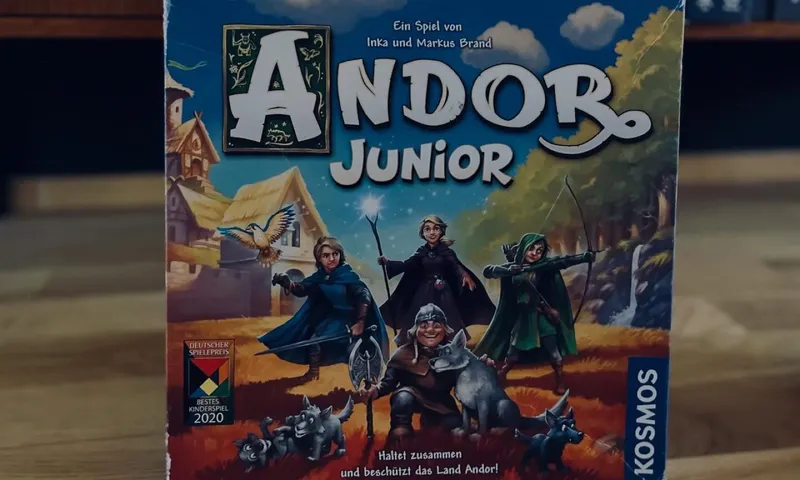
In an experiment, four- and five-year-olds shared more with other kids after a cooperative game than after a competitive one (Toppe, Hardecker & Haun, 2019). Whether that helps kids learn to lose hasn’t been studied. It fits our table, though: with cooperative games like Andor Junior, there’s far less potential for conflict. It’s hard to fight when you’re all facing the dragon together.
8. Pick your moment 🔵
With kids between four and seven, a lot depends on the mood at our table. Right before bed, when everyone’s done for the day and tired, the frustration threshold is much lower. A tight competitive game at that hour is a gamble. A short, relaxed game or a cooperative one is often the better pick.
What we take from it
Learning to lose isn’t a tip, it’s a long road, and it’s part of it that things tip over sometimes. Kids should learn that you lose sometimes and get better with every try. And just as much, that a winner doesn’t laugh at anyone. If you take away only one thing: help openly, shrink the help, lose well yourself. Time does the rest.
What works for you? And who’s the bigger problem at your table: the losers or the winners?
Sources
- Gottman, J. M., Katz, L. F. & Hooven, C. (1996). Parental meta-emotion philosophy and the emotional life of families: Theoretical models and preliminary data. Journal of Family Psychology, 10(3), 243–268. https://doi.org/10.1037/0893-3200.10.3.243
- Hays, C. & Carver, L. J. (2014). Follow the liar: The effects of adult lies on children’s honesty. Developmental Science, 17(6), 977–983. https://doi.org/10.1111/desc.12171
- Leonard, J. A., Lee, Y. & Schulz, L. E. (2017). Infants make more attempts to achieve a goal when they see adults persist. Science, 357(6357), 1290–1294. https://doi.org/10.1126/science.aan2317
- Li, Y. & Bates, T. C. (2019). You can’t change your basic ability, but you work at things, and that’s how we get hard things done: Testing the role of growth mindset on response to setbacks, educational attainment, and cognitive ability. Journal of Experimental Psychology: General. https://doi.org/10.1037/xge0000669
- Mueller, C. M. & Dweck, C. S. (1998). Praise for intelligence can undermine children’s motivation and performance. Journal of Personality and Social Psychology, 75(1), 33–52. https://doi.org/10.1037/0022-3514.75.1.33
- Toppe, T., Hardecker, S. & Haun, D. B. M. (2019). Playing a cooperative game promotes preschoolers’ sharing with third-parties, but not social inclusion. PLOS ONE, 14(8), e0221092. https://doi.org/10.1371/journal.pone.0221092
- Wood, D., Bruner, J. S. & Ross, G. (1976). The role of tutoring in problem solving. Journal of Child Psychology and Psychiatry, 17(2), 89–100. https://doi.org/10.1111/j.1469-7610.1976.tb00381.x
FAQ
How do I teach my child to lose at games?
In small steps: help openly instead of secretly losing, shrink that help over time, name the feeling after a loss and show how you lose well yourself. Little of it is firmly proven, but experts point in a fairly consistent direction.
Does praise help when my child loses?
Praising effort rather than intelligence was long seen as key. A well-known 1998 study showed this in the lab, but later, larger studies found much weaker effects. It doesn't hurt, but it's not a miracle cure.
Which games work for kids who hate losing?
Cooperative games, where everyone wins or loses together. At our table there's far less conflict with those, for example with Andor Junior.
What if my child gloats when they win?
There's hardly any research on it. At our table it's often the harder part, and usually that's when the game ends. Winning well is just as much part of the lesson as losing well.