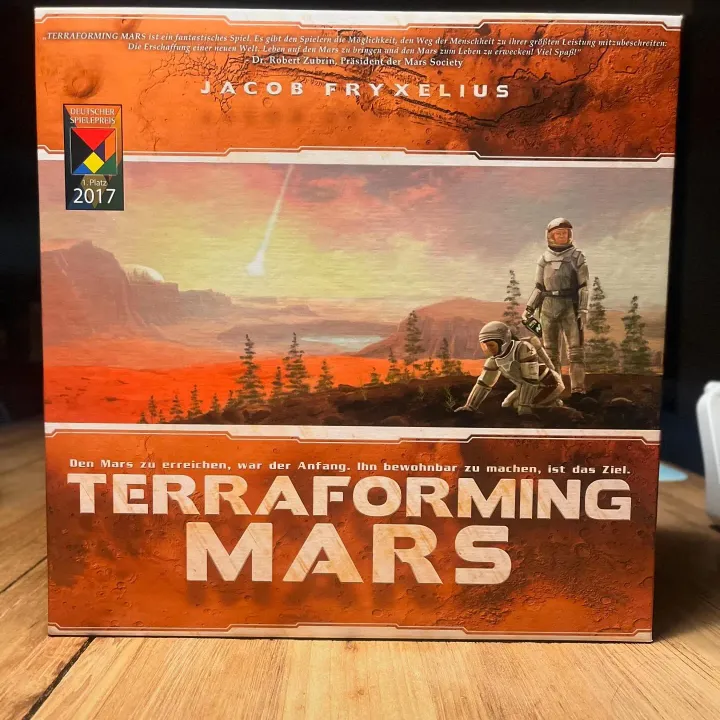
Germany was playing Switzerland at the Euros. We were terraforming Mars. That tells you most of what you need to know about this game in our house.
Terraforming Mars isn’t new, and it isn’t pretty. It’s long, it’s fiddly, and its components look like they were designed on a tight budget. And yet, two years after it landed on our shelf, it’s still one of our favorites. Here’s why.
What is Terraforming Mars?
You run a corporation sometime in the 2400s, and Mars needs fixing. Together, everyone raises the temperature, pumps oxygen into the atmosphere and adds oceans. Separately, everyone fights for the credit: points for terraforming, for cities and greenery, for milestones and awards.
It’s designed by Jacob Fryxelius, illustrated by Isaac Fryxelius, and came out in 2016 from FryxGames, with Stronghold Games publishing it in the US. The box says one to five players, 12+, and about two hours.
We came at it from an odd angle. We already owned Ares Expedition, the card-game version, and really enjoyed it. We asked our Instagram followers which one was the better two-player option. Then the big box finally moved in and made our list of new games of the month.
How it plays
The game runs in rounds called generations. Each one has three beats:
- Research. You draw project cards and pay to keep the ones you want. Every card you buy is money you don’t have for anything else.
- Action. Players take turns doing one or two actions at a time, like playing a card or placing a city, forest or ocean.
- Production. Your engine pays out, according to what you’ve built.
The game ends once temperature, oxygen and oceans are all maxed out. So everyone works toward the end together, while trying to be the one who profits most from it.
The heart of it is the engine. Early on, you’re scraping by. A few generations later, your cards feed each other, and every production phase pays out more than the last. Fitting those card combos together feels like solving a jigsaw puzzle. That’s the core of the game, and it’s where all the fun comes from.
Why it keeps winning game night
It’s simply fun. That’s not a sophisticated argument, but it’s the honest one. Once, after a long time, we finally had a game night with our neighbors again. They dared to try Terraforming Mars, and it was awesome. We had such a great game.
Single cards become legends. That night, one of our neighbors won the game with the Customs Office card (Zollamt in German). We have game nights with friends and neighbors quite often, and Terraforming Mars is one of the big boxes we bring out for them.
It gets the big nights. One evening, Germany played Switzerland at the Euros. What else could we do? Of course: a round of Terraforming Mars.
It lasts. We’ve brought it back out again, and the verdict hasn’t moved: still one of our favorites. It’s a 9 out of 10 for us.
The catch: Mars could use a makeover
Let’s be honest about the box. Terraforming Mars plays like a space epic and is dressed like a school project.
The weak spots: thin, flimsy player boards where the cubes slide around, metallic cubes whose paint flakes, and cards that are thin and hard to read at a glance. We hear that a lot in the community, too, and some even call the player boards the worst they’ve ever seen.
Then there’s the length. Two hours is the box’s promise. At four or five players it often stretches to two to three hours or more, and a player who feels behind can drag out the end. This isn’t a “quick one before bed” game. Clear the evening.
Terraforming Mars or Ares Expedition?
Since we own both, this is the question we get. Here’s how they differ.
| Terraforming Mars | Ares Expedition | |
|---|---|---|
| Board | Mars map with tiles, cities, forests | No map, no tile placement, no cities |
| Turns | One after another | Everyone picks a phase in secret, then all act at once |
| Length | about 2 hours (box) | listed 45–60 min, can run an hour or more |
Terraforming Mars
- Board
- Mars map with tiles, cities, forests
- Turns
- One after another
- Length
- about 2 hours (box)
Ares Expedition
- Board
- No map, no tile placement, no cities
- Turns
- Everyone picks a phase in secret, then all act at once
- Length
- listed 45–60 min, can run an hour or more
Ares Expedition is the tighter, faster card game. For us, it still can’t replace the original, and even some people who love Ares find its two-player games tedious. We enjoy both. If you have the evening, take the big one.
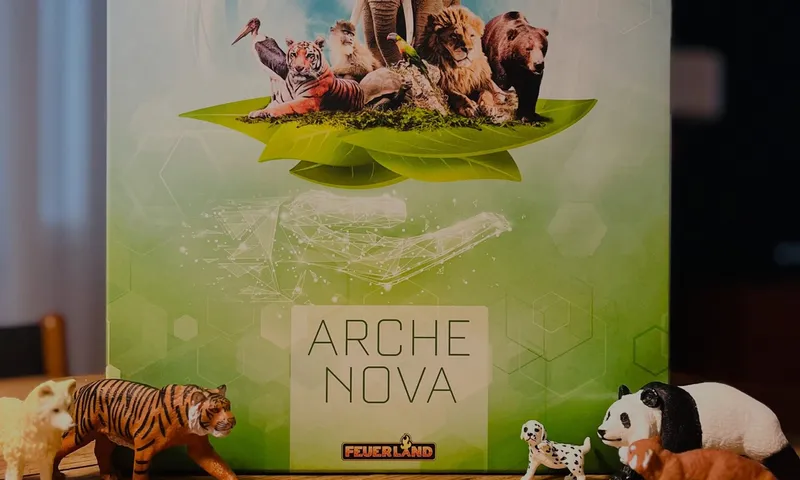
If you already love big engine builders like Ark Nova, know that there’s a lot of shared DNA: a card tableau, an income track and end-game scoring. Many find Ark Nova the better production and Terraforming Mars more thematic, with a quicker turn rhythm.
Terraforming Mars with kids?
The box says 12+. I don’t have our own kids’ report for this one yet, so I won’t pretend otherwise. What I can say: the turns themselves are simple, but the big card pool can make first games overwhelming, and experienced players tend to crush newcomers. Add the two-hour-plus length and you’ve got a game for families of all kinds with older kids who already love strategy. A mixed table with a first-grader is probably asking too much.
What we hear in the community
People praise the theme, which is built on real science, and the jigsaw-puzzle feeling of fitting card combos together. Plus simple rules, quick turns and huge replayability thanks to all the corporation and card combinations, and a solo mode that holds up.
On player count, opinions split: some call three the sweet spot, others find two the best balance of fun and speed.
The criticisms: card luck can block a strategy, there’s no catch-up mechanism, and direct interaction is low. And then there are the components. Everyone talks about the components.
There’s also a long list of expansions, from Prelude and Venus Next to Colonies, Turmoil and newer ones from 2024. We haven’t tried any of them. If you think one is mandatory, tell us which.
Our verdict
Terraforming Mars is a big, satisfying engine builder that’s earned its spot as one of our favorites. It’s the game we played during a Euros match, the game our neighbors dared to try, and the game we’re still pulling out.
If you love building a combo engine and have an evening to spare, whether you’re a couple, a group of friends or a family with teens, get it. If you want something quick, pretty or full of player-versus-player drama, look elsewhere. Mars is worth saving. It just doesn’t care how it looks while you do it.

Where it shines
- Building your engine card by card is deeply satisfying
- So much fun that it still gets picked, years after it arrived
- Great for a game night with friends: our neighbors dared to try it, and it was awesome
- A single card can win you the game, and you'll remember it

Where it stings
- Long: plan an evening, not a quick round
- Thin player boards and cubes that slide
- Mostly you build your own thing; direct interaction is limited
Fact sheet
- 1–5
- about 120 min (box)
- 12+
- Jacob Fryxelius
- 9/10
From our table
FAQ
How long does a game of Terraforming Mars take?
The box gives about two hours. With four or five players it often stretches to two to three hours or more, and solo it's about an hour or less.
Is Terraforming Mars good for beginners?
Our neighbors dared to try it on a game night with us, and we had a great game. The core rules are simple, but the huge card pool can overwhelm in the first games. We hear that a lot in the community, too.
Terraforming Mars or Ares Expedition: which is better?
We own and enjoy both. Ares Expedition is the shorter card game without the Mars map and with simultaneous turns. If you have the time, we still recommend the original.
What age is Terraforming Mars for?
The box says 12+. We don't have our own kids' experience to report for this one yet.
Do you need expansions for Terraforming Mars?
No, the base game is complete. There are many expansions, from Prelude to Colonies and Turmoil. We haven't tried any of them yet.