One piece at a time. That's the whole deal with a tile game: something grows on the table. A landscape, a stained glass window, a little realm full of dragon eggs, a spaceship.
Some of these are calm enough for a slow Sunday morning. One blew us up in seconds.
Everything here comes from our own shelf. We've played all of it, and every game has a full review with the details. Player count and age are straight off the box. Play time comes from each review, sometimes from our own games.
The quick answer
- Your youngest is between four and seven: Dragomino.
- One game for every age at the table: Azul: Stained Glass of Sintra.
- A calm puzzle for two: Cascadia.
- A quick puzzle on your own board: Harmonies.
- You'd rather laugh at chaos: Galaxy Trucker.
With kids: tile games the grown-ups enjoy too
These two work with younger kids. And the grown-ups at our table don’t just sit through them.
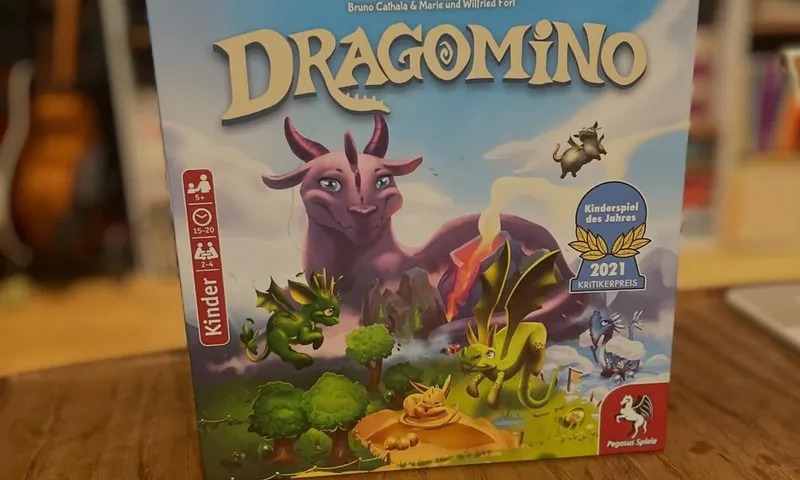
Dragomino
2–4 players · 15 min · 5+
Kingdomino, shrunk down for small hands. You take a landscape tile and match colors. Every match earns a dragon egg, and maybe there’s a baby dragon inside.
It’s our youngest’s absolute favorite. It’s also the one kids’ game we genuinely enjoy ourselves. Rare combination. The box says 5+, and for us it works from about four or five.
Bonus for parents: you can quietly steer whether the little ones win. It just looks like a turn. The honest limit: kids around eight or nine who already know board games may find it too simple. Read our Dragomino review · Should you let kids win?
Azul: Stained Glass of Sintra
2–4 players · 30 min · 8+
Same Azul heart, much prettier dress. Instead of a tiled wall, you build stained glass windows, and a glazier pawn limits where your glass can go. It’s the prettiest Azul. Every age at our table enjoys it: the box says 8+, and our 6-year-old plays along.
The catch: glass you can’t place breaks. Crash. Into the tower, minus points, and the frustration around the table is real.
It’s also a bit one-dimensional. And like Harmonies, it rarely makes it to our table, great as it is. Read our Azul: Stained Glass of Sintra review
Calm landscapes: puzzles without a fight
Here you mostly build your own thing. For a relaxed evening, or a slow morning for two, that’s exactly the point.
Cascadia
1–4 players · 45 min · 10+
The parents are playing, the kids are drawing. That’s how Cascadia hit our table on a Sunday morning, and for the two of us it was perfect timing.
You build your own landscape from hexagonal habitat tiles and fill it with animals: pick one, place one. Calm. Really beautiful.
There’s little direct interaction. Keeping track of how each animal scores takes some brainpower. If your table lives for stealing and blocking, skip it. Read our Cascadia review
Harmonies
1–4 players · 30 min · 10+
Azul meets Cascadia, plus stacking. You place colorful tokens on your own board, build them up into little landscapes and move animals onto the habitats they need. Simple rules, real depth. A game takes us about 30 minutes.
It’s mostly a puzzle you solve alone. The cards are thin and poorly coated, in a box that otherwise looks premium. And the honest part: we love it, and it still rarely gets picked.
Every shelf has that one game. Ours is Harmonies. Read our Harmonies review
Against the clock: tiles at full speed
Galaxy Trucker
2–4 players · 30 min · 8+
Tile laying as a scramble. Everyone grabs face-down ship parts at the same time and bolts them onto their spaceship before the sand timer runs out. Then the ships fly into meteors and pirates.
Our first ship lasted seconds. Then it was space junk, and we still had a great time.
It can feel random, and one bad card can sink you. We don’t have our own kids’ experience with it yet. In the community, you hear that the real-time building can feel stressful for kids around the box age of 8. Read our Galaxy Trucker review
Tiles in a supporting role
These games lay tiles too. The tiles just aren’t the heart of the game.
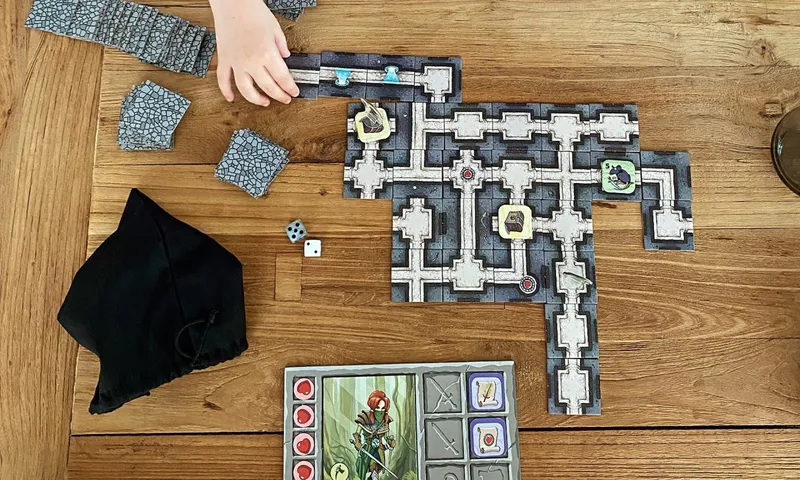
- Karak. The dungeon grows tile by tile as you explore, so it’s different every game. At heart, though, it’s a dungeon crawler for kids, and our youngest played it at four. Read the review
- Terraforming Mars. You place cities, forests and oceans on the Mars map, but the real engine is your cards. Plan an evening, not a quick round. Read the review
Where to start
Your youngest is between four and seven? Dragomino. One tile game for every age at your table? Azul: Stained Glass of Sintra. Mostly the two of you on a slow morning? Cascadia.
More games for kids and grown-ups at one table are on our family board games page.
Which tile game keeps landing on your table?
FAQ
What is a good tile laying game for young kids?
Dragomino. The box says 5+, and for us it works from about four or five. It's our youngest's absolute favorite, and one of the few kids' games we genuinely enjoy ourselves.
Which tile laying game works for every age at the table?
Azul: Stained Glass of Sintra. Every age at our table enjoys it. The box says 8+, and our 6-year-old plays along. Just warn everyone about the broken glass first.
Is there a good tile laying game for two?
Cascadia. We played it as a couple on a Sunday morning while the kids were drawing, and it fit that morning perfectly. Calm, beautiful, low on interaction.
Cascadia or Harmonies: which should I buy?
There's no clear winner. Harmonies is a tighter puzzle on your own board, with stacking. Cascadia is more open and sprawling, and its cards are clearly better made. We like both.
Is there a tile laying game with more chaos?
Galaxy Trucker. Everyone grabs ship tiles at the same time against a sand timer, then flies the result into meteors. Our first ship lasted seconds. If you hate time pressure or bad luck, skip it.